It’s really the summer of older artists laying claim to their legacies.
Paul McCartney did it with “The Boys of Dungeon Lane.” Ringo Starr accomplished it with his recent “Long Long Road.” (In August, we’ll get Carly Simon’s “Comes in Waves.”) Next Friday, it’s the Rolling Stones with “Foreign Tongues.”
Tonight, it’s Madonna’s turn. She’s considerably younger — 15 years — than those legends, but she’s been out of it music wise for 20 years, since her “Confessions on a Dance Floor.”
It didn’t seem like Madonna was going to resuscitate her recording career, she was that far gone. But one thing you can say about Madonna: she’s a hard worker. She won’t give up.
She’s proven it with “Confessions II,” a sequel dance record to the first, with the same producer arranger writer Stuart Price. After the first “Confessions,” the British Price went off to do a lot of interesting albums, many successes especially in dance music. I haven’t heard all of it, but I dare say this is a crowning moment for him.
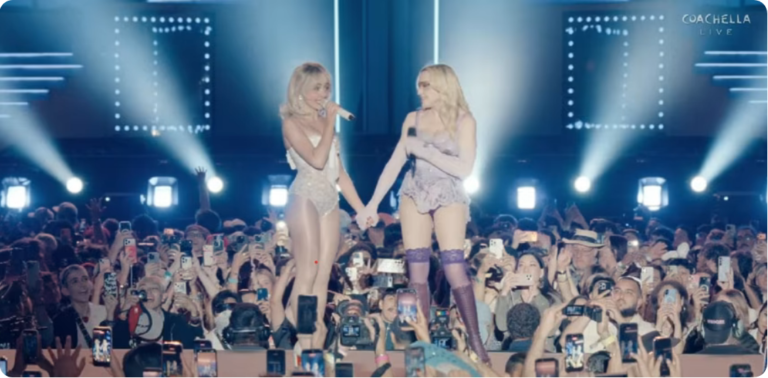
“Confessions II” is billed as a dance record, and that’s the way it starts, tipping its hand with a series of nonstop propulsive tracks. One of them features Sabina Carpenter (“Bring Your Love”) and the opening song, “I Feel Free,” is riff on Donna Summers “I Feel Love.”
The way Madonna and Price have sequenced the album is interesting because it slowly reveals itself as a collection of actual songs upon which Price has hung his unique ornamentation. In that first batch of five or six is “Danceteria,” Madonna’s four minute memoir of the early 80s, which Price ties back to “Vogue” and other early hits. It’s as if all those big Madonna hits from her halycon days were thrown into a blender, and mixed at high speed. You can tell it will be very popular with deejays.
But then things settle down and get a little more specific. “Bizarre” is a song about Madonna’s four year marriage to Sean Penn. “Fragile” is a reverie about her late brother, Christopher, who was kind of a Madonna celebrity subplot through the 80s and early 90s. “Betrayal,” my favorite song on the album, combines the legendary composer Erik Satie’s “Gnoissienne” with a mournful horn part played with stunning realness by Marco Parisi. The whole piece is like “buttah,” falling together effortlessly– but I suspect its architecture was fairly substantial. It feels more human than almost anything Madonna has done in decades.
Stuart Price must have been thinking about all this for twenty years. It’s as if he’s done a mind meld with Madonna, taking her best parts and cutting away the most self-idolizing. Where in the last two decades Madonna has seemed clueless about who she is or was, Price manages to remind her. She’s the main instrument in a symphony about herself, and he’s the conductor.
You might think, how will this all end, after 13 sort of bracing, intentional pieces– really no fluff? But it must, and does with another bit of memoir in “LES Girl,” the story of Madonna’s early days arriving on the Lower East Side, discovering New York and testing her super powers. It’s a gentle story, full of keen observation. It could be the opening episode of her Netflix mini-series. Here she and Price are joined by Andrew Watt, the producer of the McCartney and Stones albums. “LES Girl” is the perfect mic drop to an hour of meditative disco.
A lot of the album, by the way, features spoken word intros and interspersed observations. Price picked that up from “Vogue” and a few other Madonna songs, to set a tone of melancholy over his ferocious arrangements. Madonna is a guide through her wild life on this album, and you’re more than happy to follow her.
Just wait– a Grammy for Dance Album is coming, and maybe single, too. Price won the Grammy for producing “Confessions I” and not only will he get that again, but Madonna will have her own statues.
People will be surprised that I’m saying all this considering Madonna’s outsized personality, her obsession with Kabbalah and other strange parts of her 45 year career that were fun to write about. But you can’t ignore an artistic moment, one that ties together the essence of why she’s endured.