Support independent journalism, free from the trades and other publications that are part of the tinsel town machine.
For 12 years, Showbiz411.com has been covering Hollywood, Broadway, the music business and the business of celebrity. Ads are our main source of funding, but contributions (not tax exempt) from readers who enjoy the scoops, exclusives, and fact based reports are always welcome and very appreciated. To inquire about ads, email us at showbiz411@gmail.com.
“Mrs. Doubtfire” isn’t coming back to Broadway so fast.
The musical version of the Robin Williams movie opened on December 5th but then COVID arrived. Cast members became ill, shows were cancelled, and then the Omicron took its toll.
Producers decided to shut down until March 15th. But beware the Ides of March. Broadway, shrunk from 30 shows on New Year’s Day to just 19 this week, is still suffering. The box office on January 2nd was $26 million. Last week it was just $18 million.
Now producer Kevin McCollum tells the New York Times that “Mrs. Doubtfire” won’t return before April 14th. There are some people who think the show may not return at all, but McCollum is a man of his word. He’s trying.
McCollum tells the Times that without tourists yet, there’s no point. And COVID is not over in New York by a long shot. It’s just that people are tired of it, or in showbiz terms, “so over it.” Nevertheless, there were 2,100 new cases in New York City yesterday. So keep that in mind. I know two people who’ve tested positive in the last three days. They were completely vaxxed.
“Mrs. Doubtfire” was panned, naturally, by the Times and received middling reviews elsewhere. Still, it’s an original musical, which Broadway is in need of this season. It requires time and patience and some awards love in the spring to keep it going. I haven’t seen it, but hope to when it returns. Let’s give it a chance. Every show needs one right now.
Alec Baldwin obviously doesn’t understand the meaning of optics or “not now” or “read the room.”
The Bennington, Vermont Banner newspaper reports that Alec and his attention seeking wife Hilaria (nee Hillary) have purchased a 55 acre spread for a reported $1.75 million. The property, says the Banner, has been described as a “classic Vermont 18th century farm [that] features 55 beautiful acres, a 3,600 [square foot] main house, and a nicely renovated 1800 [square-foot] guest cottage with 2 baths.”
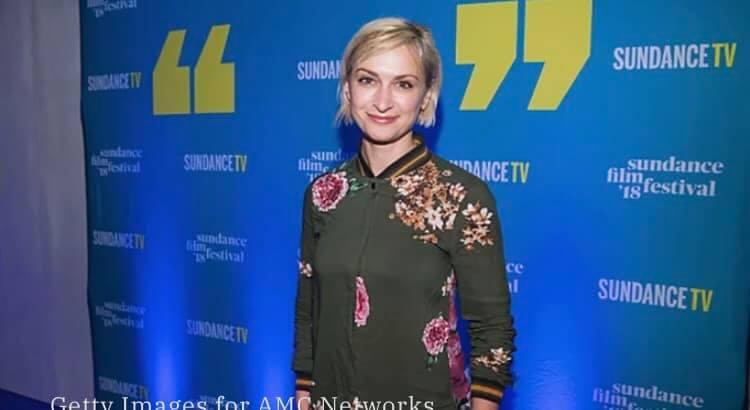
You may recall that after Baldwin allegedly killed cinematographer Halyna Hutchins on the set of the low budget movie, “Rust,” Hilaria loaded her six kids into the SUV and drove “aimlessly” until she came upon Manchester, Vermont. Baldwin joined her there, where they camped out and confronted reporters.
The whole Vermont adventure was depicted as a fluke, when in fact, Hilary Thomas’s family had owned land up there for years. So it was not a random trip, that was lie, just like the whole mishegos about Hilaria coming from a Spanish background. She’s white shoe WASP from New England.
Alec Baldwin seems not to care how his actions are interpreted. After the shooting, he and Hilaria kept posting happy family photos to social media, and they’ve been doing it ever since. Is it any wonder that Halyna Hutchins’ widower, Matt Hutchins, filed a civil lawsuit against Baldwin this week? After Alec told George Stephanopolous in a very ill-thought out interview that he and Hutchins were pals and so on? Matt Hutchins can only be furious and inflamed as he comforts his 9 year old orphaned son that the man who allegedly killed his mother is enjoying himself three months later.
Let’s hope the Baldwins enjoy their new house, and don’t have to give it up in civil settlement over Halyna Huchins’ death.
There is a reason why records need producers, not just the artists making the record.
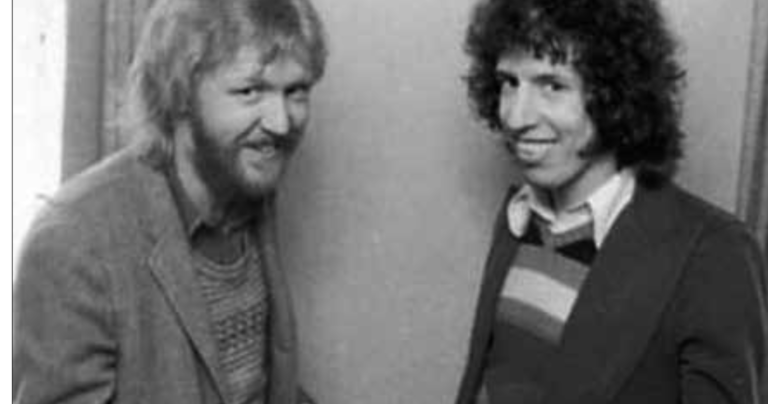
Case in point, of the great records of all time, “Without You,” by Harry Nilsson. Fifty years ago today, “Without You” began a four week run at number 1 on the Billboard charts. The album it came from, “Nilsson Schmilsson” also went to number 1.
Two more hit singles came out of, “Coconut” and “Jump in the Fire.” Nilsson, famous for “Everybody’s Talkin’ at Me,” hadn’t had a hit in two years, and would never have one as big as this again.
“One night, working late, Harry did a demo of “Without You,” just him pounding the piano keys so hard you could feel his fingers bleeding, and singing as if his throat were being torn apart. By this point though, Harry had grown to hate the song. He said that it was just a piece of pop fluff—but he felt that this kind of over-the-top, angst-filled vocal performance might give it some sort of credibility. He wanted this demo to be the record! He said, “You never hear a performance like this on a record,” he insisted and I told him there was a good reason why. I felt like I literally had to twist his arm to do.
It was midnight when we gathered to cut the track for “Without You.”
I made a few changes in the rhythm section with Jim Keltner, another one of my favorite drummers, Gary Wright of “Dream Weaver” fame on piano, John Uribe on acoustic guitar, and Klaus Voormann back on bass. I started to carefully mold the track into shape with the musicians, giving special emphasis to the dynamic contrasts that the song was based upon. But when I would ask the musicians to come in for a playback, Harry would say to them, “Does anybody know what this song is about? How could anyone like this song?” I had to take him to a private room and implore him to stop sabotaging our efforts to make a proper track. He was playing dirty pool. Finally, I came up with a strategy to get him to stop: I told him that if he didn’t like the new track better, we wouldn’t use it. I was already totally convinced that we were on the verge of making a very special record. Much as I hated having to make that concession, the promise I made proved to be an effective way of silencing Harry. Without any further interference, in less than an hour, the basic track was done, other than some careful editing to select the best drum fills and insert them into the master. a proper track with musicians.”
The next day, I let Harry know that we were ready for his vocals, but he said he needed to have a meeting with me first. We met in the lounge of the Dorchester Hotel at four o’clock that afternoon for high tea, and I was eager to hear what Harry had on his mind. Not in my wildest dreams did I imagine he would tell me that he still liked the demo version better! After exhausting my considerable powers of persuasion, I reminded him of the commitment he made when he agreed to let me call the shots. He looked me dead in the eye and uttered a vintage Nilsson reply: “Well, I lied!” Vexed, I looked at my watch and saw that it was six o’clock. “Holy shit, Harry,” I said, “we’re booked in the studio RIGHT NOW!” Without another word, we hustled out of the Dorchester, jumped into a taxi, and got to the studio where everything had been all set up for his vocals.
It was a once-in-a-lifetime performance! Harry was at his best. Not only did he deliver a Grammy Award–winning vocal, but we also never discussed the demo version again, nor did we have the slightest conflict for the duration of making the album. I never did understand the reason for Harry’s fortunate about-face, but I figured it was best not to ask.
“Without You” is as much a tribute to Nilsson’s voice as it is to Perry’s memorable, rich production. He would soon follow it up with Carly Simon’s “You’re So Vain” and Ringo Starr’s “Photograph” among the greatest and most enduring pop singles in history.
There’s a new Tom in town, and his name is Tom Holland. He’s the king of the box office this morning.
“Uncharted” has a $15.4 million opening including the $3.7 million from previews. “Spider Man” earned another $1.7 million last night as well.
He is only 25, but Holland has the number 1 and number 4 movies. If the Academy doesn’t get him to appear on the Oscars in some form, I don’t know what will happen.
Not to mention: Holland’s girlfriend, Zendaya, is turning in an Emmy worthy performance on the most talked about TV series, “Euphoria,” on HBO. She’s also his co-star in “Spider Man.”
These kids are the Mickey and Judy of this generation! The sky is the limit.
In other box office news, “Marry Me” did a million bucks last night, off 64% from last Friday, but about what it did on Monday, Valentine’s Day.
Channing Tatum’s “Dog” opened with $5 million and will be barking up the wrong tree over the weekend. But this just Channing’s tentative comeback. His next one, “Lost City of Z,” with Sandra Bullock, looks like an old fashioned hit from the trailer and commercials.
PS All of this must be peculiar for Tom Hollander, another British actor who is quite terrific in all his films. He has a boatload of awards and nominations.
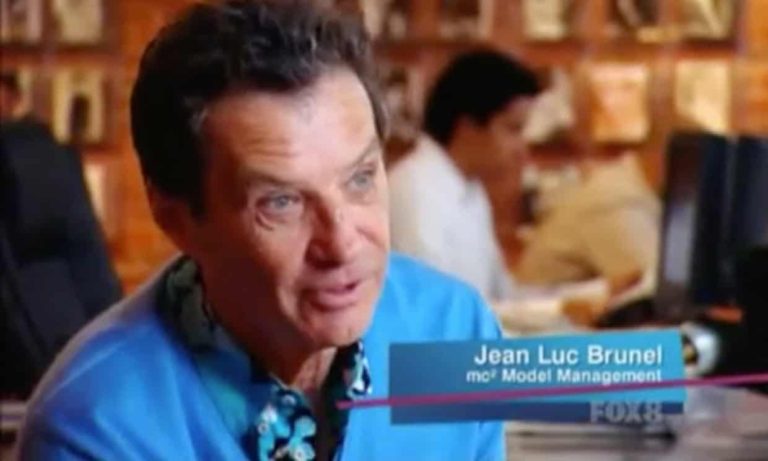
It’s the end of a long story. I first wrote about him in the New York Observer in 1991. He had already then been profiled by Diane Sawyer on “60 Minutes.” I wrote about him because he was the silent partner in a new modeling agency. He was already then accused of grooming and sleeping with underage models.
Flash forward to the present: unchecked despite numerous subsequent stories in the media, Brunel hooked with Jeffrey Epstein and Ghislaine Maxwell in their procurement of girls around the world. He wound up in a French prison, accused of rape. One of his victims was Virginia Roberts aka Virginia Guiffre, who just settled her case against Prince Andrew for $14 million.
And now Brunel is dead, likely a suicide. But if murdered, there are so many candidates.
Like Epstein, Brunel was found hanging in his cell. It seems like the right ending for him.
According to reports, Giuffre claimed in August 2019 court documents that Brunel was one of the men Maxwell had directed her to have sex with while still a teenager. Guiffre claimed in a 2015 affidavit that Epstein bragged he had “slept with over 1,000 of Brunel’s girls.”
But I knew about Brunel three decades ago. In The New York Observer I reported that he was the silent partner in Next Models, a new company formed by New York model execs Faith Kates and Joel Wilkenfeld. They denied the association, but a number of people connected to them confirmed it.
When I was reporting the story in ’91 about Kates and Brunel, I was pointed to the “60 Minutes” story. Since there was no YouTube then, I called Esther Kartiganer, the famous editorial director of the newsmagazine. She invited me up to West 57th St to watch the 1988 segment on a monitor in her office.
Brunel was often accused in Page Six of something that was quaintly called “modelizing” back in the day. He was in his 40s then, and was among a group of men who owned model agencies and were seen nightly in clubs with very tall, very young looking girls. Donald Trump was so excited by the idea, he briefly had his own modeling agency.
No one will miss Jean Luc Brunel. He’s better off dead. although it’s a shame he will never be tried for his crimes.
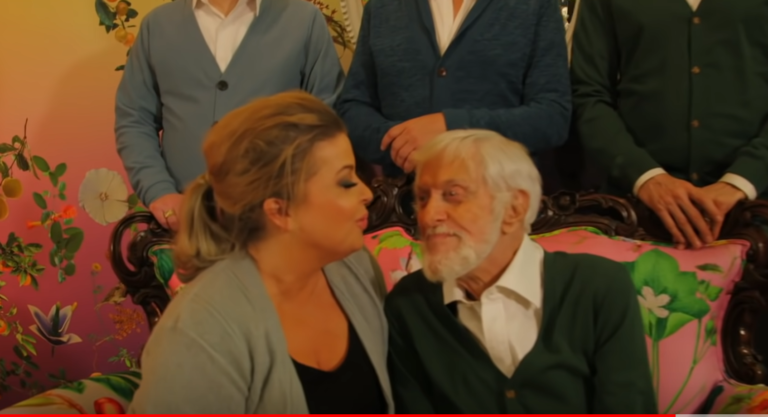
Want to know what keeps Dick van Dyke young at 96? Watch this video directed by his wife, Arlene Silver, and sung by her. Dick shimmies around and if you wait for it, at the end, there’s a cute nod to his famous TV series. And well sung by Arlene! These two are having fun!
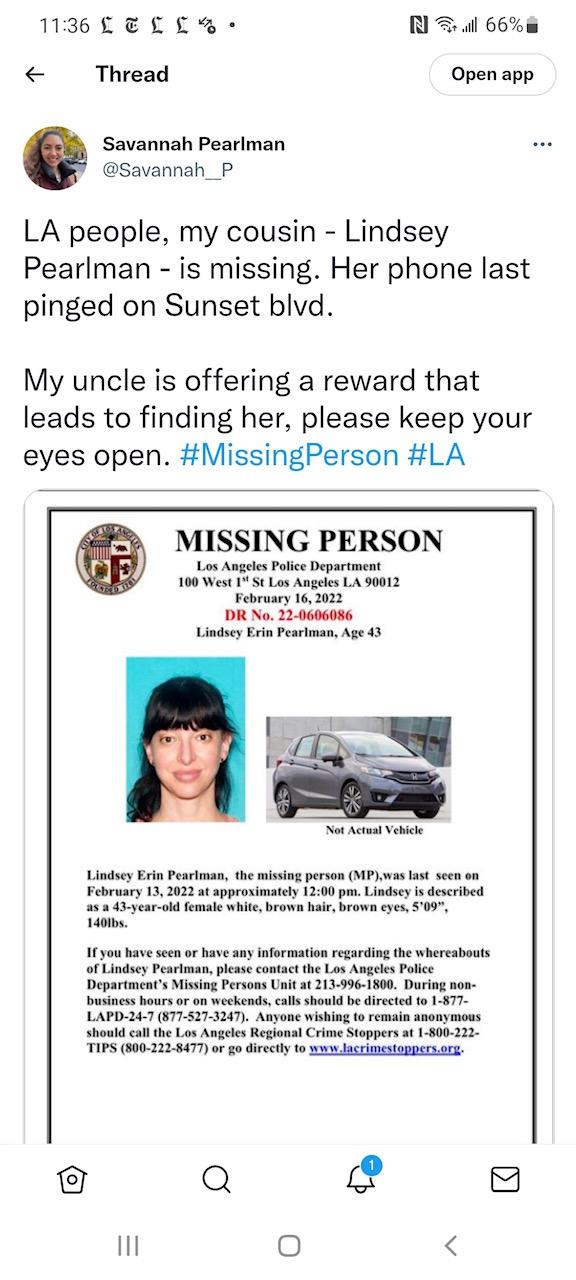
UPDATED Cousin Savannah Pearlman: “I’m deeply sad to report that they have found Lindsey, and it was too late. I have no other information about the location or circumstance. Lindsey was a fierce animal advocate and a talented actress. Please consider a donation to @SanteDOr in her honor.”
Saturday morning: Savannah posts that Lindsey’s sister urges anyone needing help to call the Suicide Prevention Line. “Please know that you are never truly alone. Lindsey’s sister has asked that we share the National Suicide Hotline: 1-800-273-8255.”
Condolences to the family. Tragic.
EARLIER Actress Lindsey Pearlman is missing in Los Angeles. Her cousin Savannah has filed a Missing Persons report which I’ve reproduced below.
Pearlman, from Chicago, is 43 years old. She has a long list of credits including the recent “Selena” miniseries and a short run on “General Hospital.” She’s recurred on several series in the last couple of years.
If anyone has any information please use the info below immediately.
Savannah says on Twitter: Lindsey drives a dark silver 2015 Honda Fit. CA license plate # 8ASD502.”
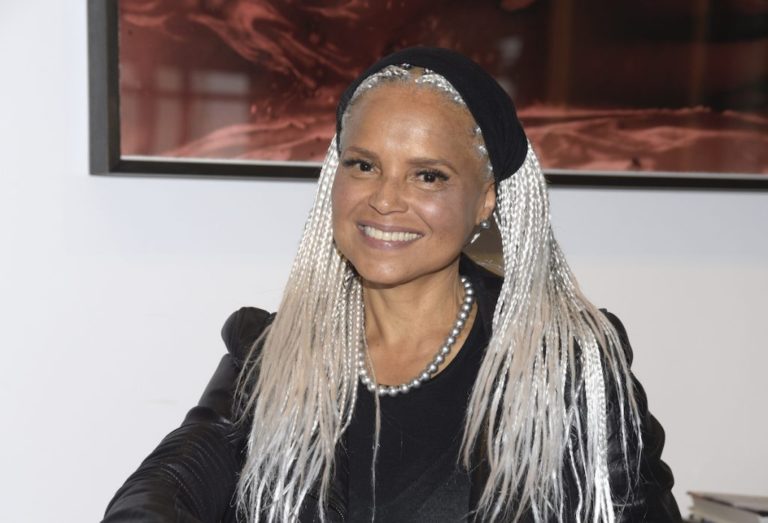
The CBS hospital drama has booked Victoria Rowell for a recurring role.
It’s about time Rowell returned to CBS. From 1990 to 2007 she was a regular on CBS’s “Young and the Restless” playing Drucilla Winters. But in 2007 her character was killed off in a vague way, and Rowell wound up suing the network over diversity. She also wanted her job back, and she should have gotten it. She was treated very badly by the show and Sony Pictures TV.
The fact is, Rowell was ahead of her time. She was demanding parity and diversity a decade or more before there was support for the cause. The case ended in a confidential settlement. The complaint garnered national and international press attention, with Rowell claiming victory in the (UK-based) Daily Mail, noting, “As for winning, I have won, exposing this unacceptable racist and retaliatory behavior in 21st century America.”
Rowell was twice nominated for Daytime Emmys and has won 11 NAACP Image awards. She stars in, writes, directs, and produces “The Rich and The Ruthless” on BET. I had lunch with her once years ago when she published a book about trying to survive in Hollywood. And she’s done it, beautifully.
So they’re suing the ex CEO who they all ran down to court and supported in 2020. That’s Michael Gyure, ironically pronounced “jury.”
You may recall that Gyure was found guilty of tax evasion, and caused the club to be raised by the feds. All the members went down to the federal courthouse to support Gyure despite his breaking the law. And then they let him return to the Friars Club like nothing happened.
And now the Friars are suing Gyure for embezzlement. There is no honor among thieves, you see.
Meantime, the Friars think they’re having a ‘roast’ in May and honoring comedian Tracy Morgan. Maybe someone should tell Morgan that the club is still strongly associated with Bruce Charet. It was Charet who caused the club to be sued for sexual harassment by their former receptionist, Rehanna Almestica. She won a settlement of just under one million bucks.
Usually when that happens, the firm that settles gets rid of the person who caused the problem. But Charet thrives and is held in high esteem at the Friars Club. He has not one but two websites on which be brags about his ties to the Club.
Gyure, 54, allegedly secretly owned an entertainment company while running the Friars Club, The Friars say he signed over the right to the use the Friars name “in perpetuity” to that business without the club’s knowledge or permission. The claim is filed in a Manhattan Supreme Court lawsuit.
The company Gyure owned never paid the $150,000 fee to use the name. After Gyure’s business lost more than $616,000 on a January 2015 event, he used Friars’ funds to cover the loss, the Club claimed. The Friars are demanding $2.3 million in damages.
You have laugh. After the 2017 raid, the Friars totally supported Gyure. He was given a new contract after his 2019 guilty plea for filing false tax returns and failing to disclose $433,000 in income.
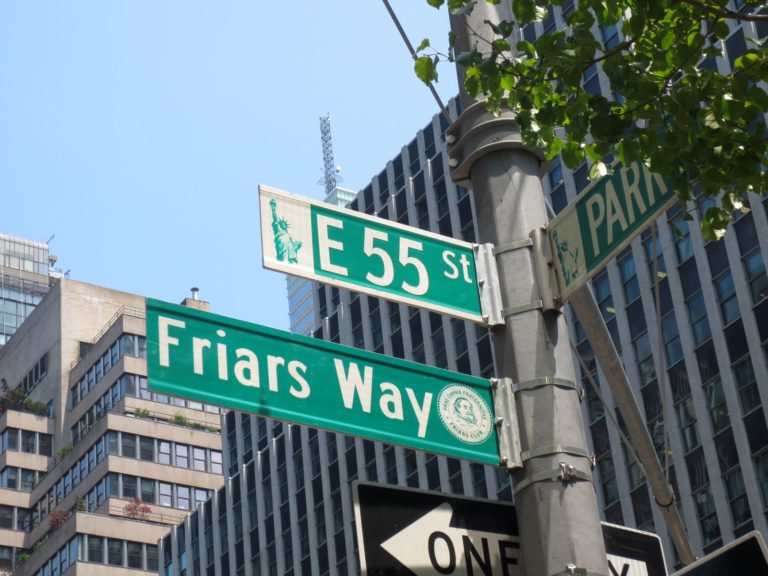
Charet, meantime, last year held himself out on a radio show as “Larry King’s manager” after the famed radio and TV star died. And despite the terrible publicity from the sex embarrassment lawsuit, the Friars refuse to rid themselves of him. The Club recently re-opened after closing during the pandemic and suffering a massive flood through their East 55th St. building. The Club has had a lot of renovations which they luckily gained through insurance money.
And let’s not forget that the Friars, which was run as a 501 c3 charity, lost their designation last year. So whatever they’re raising money for with the Tracy Morgan event, it’s unclear where that money is going.
You can read articles I’ve written about the Friars here, including how in2019 they honored a guy named Rinaldo Nistico, who goes by the name “Ronnie Shoes” or “Ronnie Copa.” Nistico was indicted and settled a case in 2004 for assault. The NY Post reported then that Nistico had two prior arrests and convictions on weapons charges in 1990 and 1996.
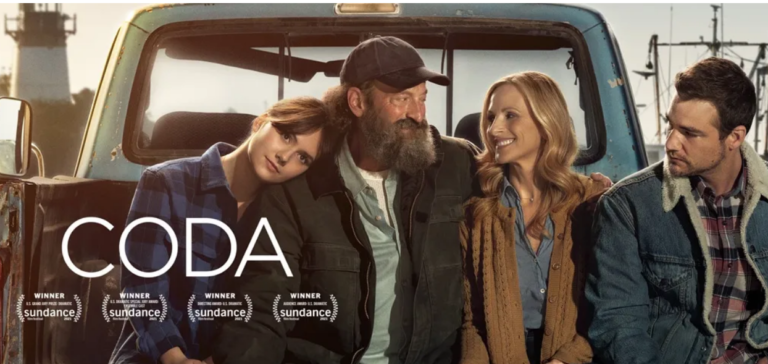
This is interesting. “CODA,” a movie everyone who’s seen it loves, is finally getting a major marketing push from Apple Films.
Apple is putting “CODA” into major market theaters across the US and in London for FREE the weekend of February 25th. Of course they will be close captioned (and I wish all studios including Apple would close caption review links also).
Directed by Sian Heder, “CODA” is nominated for three Oscars: Best Picture, Adapted Screenplay, and Supporting Actor (Troy Kotsur.)
The film premiered at Sundance 2021 and was finally released mid year on Apple Plus TV. But otherwise, it’s had a very low profile. This is a major shot across the Oscar bow by Apple to try and get Academy Award wins. Audiences at a special showing in Los Angeles will have the opportunity to be part of a live Q&A with the cast and writer/director Siân Heder, which will have translators in ASL.
You never know. This might work.
First come, first served. If you love good movies, and want to take your teens to something you can each enjoy and discuss, “CODA” is it.