
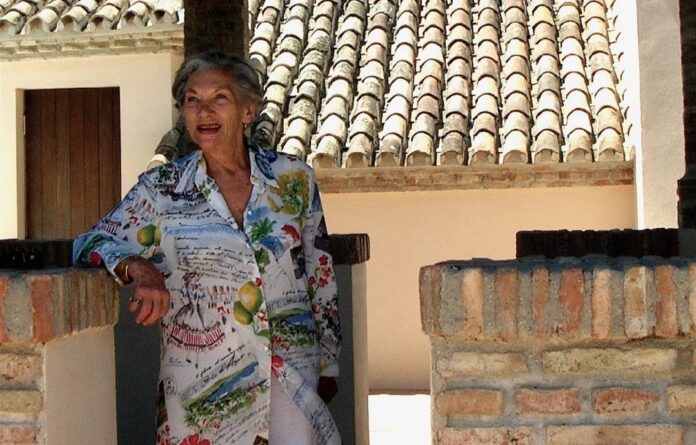
Last Monday I got the call from my great friend, Martha Rose Shulman, the cookbook author, that Christine Ruiz Picasso had died at age 97.
Martha introduced me to Christine in the spring of 1986 when they came from France for the 25th anniversary of the Pace Gallery. The Gallery was also showing Picasso’s notebooks for the first time, and I was involved in their publication as a book called “Je Suis Le Cahier: The Notebooks of Picasso,” which Harry Evans guided at the Atlantic Monthly Press. I was the publicist.
Christine was the widow of Picasso’s eldest son, Paulo, who died two years after his father in 1975. Christine and Paulo had a son, Bernard, a couple of years younger than me. She had never been to New York (she was about 58 then), but Martha promised her that for two weeks we would be her guides.
It was one of those significant moments in a life. I was 29, and immersed in Picasso. I was already working with Picasso’s daughter and son, Paloma and Claude, but Christine was their favorite relative.
I could see why when I met her: she was grounded and spiritual, with dancing eyes and softly graying hair. She had enormous style and was avidly interested in meeting everyone, and seeing New York. Having been through constant battles with her husband, father-in-law, and the family, Christine was free finally to live her life. In 1981 she’d moved to Provence, bought a 17th century farmhouse, and built a one bedroom main house for herself. As she said, the guests could stay in the “mas.” She was done taking care of people.
The property — sitting high on a hill in the Luberon — was called Terre de Cavalier, and we all visited it many, many times over the years. Christine was a gourmet cook, and she loved to talk — albeit in French, a language I didn’t know. But with Martha and others translating over many summers, we got to hear the full story of Picasso, his art, his family, and his women. It was an incredible ongoing tutorial, delivered by a witness to history.
Christine, as Paolo’s widow, inherited a huge collection of Picassos — more than I can describe here. So did her son, Bernard. Over the years, they created the thriving Picasso museum in Malaga, Spain, Picasso’s birthplace, donating at least 285 pieces. Many of the artworks I knew, as if they were old friends, from the Paris apartment and the Provence farm. I’d slept in bedrooms with them, sat under them for breakfast. The museum so changed Malaga that when we all went to the opening and walked through town, Christine was greeted as a queen. She curtsied, and accepted the role with humility and grace.
The Picasso family was always publicly contentious, with lawsuits over everything. There was a lot of drama: grand suicides, selling of art behind backs, squabbles over endorsements, and so on. The one peacemaker was Christine. She lived for a long time in St. Germain, off the Rue du Vieux Colombier, in a very grand old fashioned floor through apartment. I recall one time when Paloma, who’d stayed close to Christine even after her own father wouldn’t see her, visited for tea. When she saw Christine’s trademark red couches, she almost cried. This was a woman and a place she loved.
At different times, Christine’s mother had lived with her, and of course, Paulo, who took another place in the building with his mistress when he was dying. This was very French. But after all these soap operas calmed down, Christine used Cavalier as a retreat for poets, musicians, scientists and artists. She’d finally found peace. I was so lucky to have been included in this new world.
The Picasso story wasn’t Christine’s only saga. She had a surprising backstory, which I learned right away. She’d grown up without a father. At the end of World War II, her mother informed her that her biological father — whom she’d known nothing about — was a member of the Lazard banking family dynasty. She told her that Lazard, who was Jewish, had died en route to a concentration camp. Not even his immense wealth had saved him from the Nazis.
This was a shock, to learn that a father she never knew was gone. How did this happen? Sixteen year earlier, Christine’s mother had been Robert Lazard’s nurse (he was considerably older). It’s like a story from a grand historical novel. When reparations were made, Christine’s half-brother graciously gave them to her and her mother. They bought a small hotel in the 6th arrondissement, which is where Paulo found her after she met father and son on the beach in the South of France.
This whole story was kind of a continuous oral history lodged in my head. Christine’s explanation of events, her observations, and surmises about what happened in that family were told with drama and humor and overall, exasperation. Who will tell your story, they sing in Hamilton? It was Christine who told the Picasso story, from a perspective few could imagine.
One time, we all visited Vauvenargues, the castle Picasso owned near Aix-en-Provence, and where he was buried with his second wife, Jacqueline. We took a tour, and as we wound our way through what is now public two months every summer, Christine began muttering under her breath in French. She was correcting this poor American girl who’s memorized the material. Finally Christine couldn’t stand it any more and spoke up, saying ‘No, you’re wrong’ to the guide. Everyone in our little group was startled. Who is this woman, they demanded to know?
A Picasso, I said. A real Picasso. They nearly fainted.
How did forty years go by so quickly? It’s a shock. For so long, Christine was the center of a universe in a magical place so far from our world. She was very much in the present and so tied to a famous past that almost no one had access to anymore. Not only did she outlive Pablo and Paulo, but also Picasso’s son, Claude, and his mother, Francoise Gilot, as well as Picasso’s other daughter, Maya. One by one, the people who’d battled with and over the greatest artist of the 20th century, had disappeared into the mist. But we still had Christine, who’d survived it all. She was our shining oracle, and will never be forgotten.

