
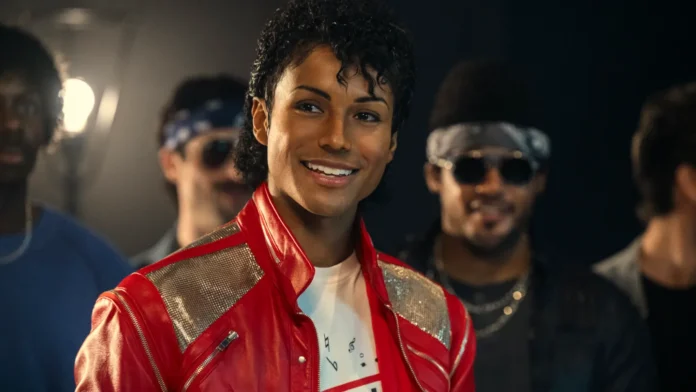
Fans of Michael Jackson are chomping at the bit for a biopic.
This week, they get one with Antoine Fuqua’s “Michael.”
The problem is the die hard fans don’t accept the deceased King of Pop as a human being full of frailties and mistakes. They want an idealized survivor of the slings and arrows of outrageous fortune, a misunderstood artistic genius who created himself with no help from anyone else.
Fuqua has made the movie they wanted. “Michael” is fact free and devoid of depth. But it serves a purpose: to reinforce the love and admiration of a one dimensional figure preyed upon by his father, a star who struggled for personal freedom — and to make his own kind of art. If you just want to see Michael’s videos reenacted, “Michael” can be thrilling.
Playing Michael is Jaafar Jackson, Michael’s nephew, the son of his older brother, Jermaine. Jaafar has talked about practicing Michael’s singing and dancing for years to get it right. He gets an A. When it comes to reproducing Uncle Michael, Jaafar is earnest and dedicated. He plays to Michael’s endearing softness, his whispery Marilyn Monroe voice, love of animals, and comfort with children (and toys) without irony. He and Juliano Valdi — a treasure as young Michael — dance up a storm.
All of that works. But then it doesn’t. “Michael” ideally is supposed to follow the pattern of other successful music biopics, like “Bohemian Rhapsody” and “Rocket Man.” But the main characters in those — Freddie Mercury and Elton John, respectively — were fleshed out. We learned so much about their reactions to their difficult inner lives that they become sympathetic. Also, in those movies, the heroes had tremendous support characters. In “Michael,” that would have been Janet Jackson, but she refused to portrayed. With “Michael,” the main character remains an enigma. Screenwriter John Logan, who’s humanized ciphers like Howard Hughes and even James Bond, has trouble piercing the mystery.
“Michael” plays with facts as if they were alternative. Missing from the 70s is his role in Sidney Lumet’s movie of “The Wiz,” where the famed choreographer Bob Fosse helped him perfect dance moves like moonwalking. “The Wiz” was what gave Michael the idea for a solo career. It would have been a perfect dramatic beat. Also absent are Michael’s influences, like James Brown and Jackie Wilson. As far as the movie is concerned, Michael is sui generis— self-invented.
That part becomes evident when the movie, gets into what fans want to see: the creation of “Thriller” the album and its historic dance videos. Choreographers Bob Giraldi, Jeffrey Daniel, and Michael Peters are absent, as is director Martin Scorsese. Producer Quincy Jones –who gave Michael a world in which to create — gets perfunctory appearances. You’d never know he was a famous producer, composer, and conductor who made any real contribution to Michael’s unique burst of stardom.
The screenplay gives Michael a buddy and protector in Bill Bray, the bodyguard Joseph Jackson assigned to his son. Bray — played by KeiLyn Durrel Jones — is set up as a sympathetic ear for Michael since Joseph is driven (we never learn why) to make his sons stars even if that includes physical abuse. Bill Bray did his best to shield Michael (and in real life his reward years later was being ignored). Colman Domingo conveys Joseph’s sinister side, almost to the point where he plays him as Snidely Whiplash twirling a mustache.
The filmmakers gloss over Michael’s devoted manager Frank DiLeo, who’s unnamed in the film and seen briefly in two scenes (and played by an unknown actor). DiLeo, so key to Jackson’s career, is joined by Mike Myers as head of Columbia/Epic Records, Walter Yetnikoff. They appear in the Epic Records offices without being identified. Myers plays Yetnikoff closer to his “Coffee Talk” mother-in-law than the peripatetic record executive.
As far as DiLeo goes, the movie simply erases his importance to Michael in the 1980s. It was Frank — who I knew well — who masterminded the “Off the Wall”-“Thriller”-“Bad” trilogy of smashes. But the movie is comfortable giving all credit to Michael’s lawyer, John Branca, played by Miles Teller, who Jackson met around 1980 and has run his estate since he died in 2009. Much as Branca made good deals for Michael over the years, it’s amusing to see him as the singer’s confidante and conscience. (DiLeo also wrote most of Michael’s book, “Moonwalk,” edited by Jacqueline Onassis. But that’s another story.)
On a side note, there’s nothing about Jackson recording three duets with Paul McCartney, scooping up the Beatles catalog behind his back, or the purchase of Neverland.
And what about the Jackson 5? The actors who play them have almost no lines. They linger in the background as silent cheerleaders, grateful to be sidelined. Did they resent Michael’s success? (Yes.) Without him, they couldn’t earn a living. Joseph Jackson understood that. We get a little bit about the father continually attempting to lure Michael back into the fold, but it’s all surface. In real life, the father and brothers got more and more desperate as Michael’s career soared. That alone would have informed some drama.
The movie suffers from having no third act. In Fuqua and Logan’s original version, which was shot, Michael faces the scandal of being accused of molesting Jordan Chandler, paying his family off. The point was to show some kind of exoneration. But it turned out the Chandler agreement prohibited that story from ever being told in a film. So a new, unsatisfying ending was cobbled together. But I would have ended the movie by fast forwarding to the brothers reuniting at Michael’s 30th anniversary concert in 2001, relieved to finally be included in his adult success.
The filmmakers keep stoking the idea of a sequel, but that’s not a good idea. This movie ends in 1988, when Michael is on a high with the “Bad” album, which was followed by a tour. But shortly thereafter, in real life, Jackson’s story became very dark. He went from being an adult playing with toys in his room to having sleepovers with children. There are more accusations, hidden settlements, and two strange marriages that ended in divorce – and children. There was also a lot of eccentric behavior and inability to cope with suspicions about his life.
A sequel would open a Pandora’s box. Because even if Michael is innocent of every charge, there’s no way to present everything that happened without including legit factual information. The public discourse would overshadow any of Michael’s musical achievements. For example, The Estate would not allow the details that to be re-created, like Michael dangling a baby out a window. The Jackson family would be better off producing a documentary mini series that makes a case for Michael has a hounded innocent. (There are already two or three unauthorized documentaries playing in England. I’m actually in one, briefly.) But there’s nothing entertaining about what really happened after “Michael” ends.
Bottom line: “Michael” is a fanzine. If you take it at face value, you’ll leave the theater humming — and twirling.

