
Julian Schnabel is not only a world famous classic artist shown in the best museums and the most important galleries. He’s also a respected filmmaker of award winning movies like “The Diving Bell and the Butterfly,” “Before Night Falls,” and “Basquiat.”
Schnabel showed his newest film, a much anticipated passion project called “In the Hand of Dante,” at the Venice Film Festival recently. Top critics on Rotten Tomatoes loved it. Bloggers weren’t so sure. Soon more critics will see it, and “Dante” will probably open early next spring.
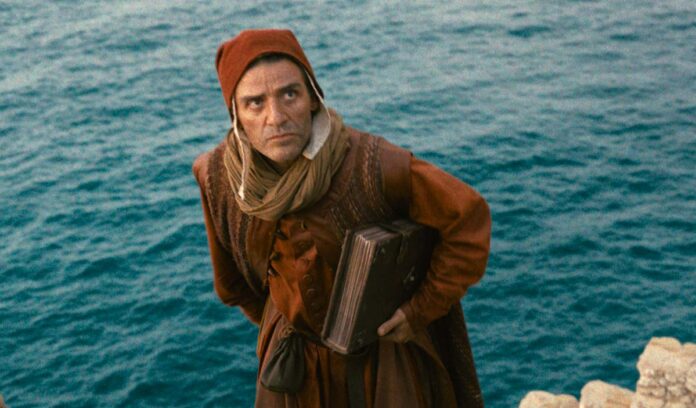
I got to see “Dante” this week, and it’s magnificent. The movie is based on a literary thriller by the late great author Nick Tosches in which he casts a fictional version of himself — played by an all encompassing Oscar Isaac — on the hunt for a previously unknown manuscript of the famed 13th century poet Dante Alighieri’s “The Divine Comedy.” (FYI Dante’s other great work, “The Inferno,” presented the author as a fictionalized version of himself.)
The Nick character — innocent and earnest at the beginning and something 180 degrees away by the end — is enlisted by a shady mob guy (a perfectly squirmy and sinister John Malkovich) to find the manuscript and authenticate it. Of course “Nick” falls in love with a beautiful associate (Gal Gadot), who’s also in on the effort. He’s also tailed by a psycho mob goon (a surprisingly pungent Gerard Butler in maybe his best work ever). The film proceeds on two levels — Nick’s investigation in black and white, and the imagined “real” story of Dante, which is told in a saturated color palette.
That’s a lot of movie right there but that’s not all: Al Pacino sets the story up, and later director Martin Scorsese has an extended and memorable not-to-be-missed cameo in the Dante plot as a wizened oracle. Jason Momoa — freed from comic book movies — plays a dark, menacing character following “Nick.” Among others in the large cast are the excellent Louis Cancelmi from “Billions” and Sabrina Impacciatore from “The White Lotus.”
“In the Hands of Dante” was shot by Roman Vasyanov alternately like a trip to the Louvre and another to a downtown Italian social club. Because he’s such a gifted artist, Schnabel knows images. Almost every scene of this movie is frame-able. Filmed in photogenic Italy, the production is alive in every scene. It’s a two and half hour movie but there’s nary a slow spot. You can’t take your eyes off of it.
The movie also has a knockout score by Benjamin Clementine, who also has a startling cameo. Schnabel wrote the screenplay with his wife, Louise Kugelberg.
Schnabel still has some slight tweaking and trimming to do, which is no surprise considering this huge undertaking. (There’s a particularly gruesome torture scene that needs a lightening up. Also, the ending is wild, but maybe appropriate for this Italian opera.) He can do it.The director has made complex movies before, like the excellent “At Eternity’s Gate” about Vincent van Gogh. In “The Diving Bell,” most of the movie was from the point of view of the eye of a paralyzed man and received four Oscar nominations.
But in the hand of Schnabel, Tosches’s material comes alive in brilliant and unexpected ways. This is the kind of movie we used to see from the great auteurs of the 70s like Scorsese, who is also executive producer of this film. “In the Hand of Dante” is the kind of exciting work we see infrequently now — like “The Brutalist” — and need so much for cinema to survive.
We’ve got a lot to look forward to next year.

