
The first time Paul Thomas Anderson tried to adapt a Thomas Pynchon novel, I liked to call it “Incoherent Vice.”
The film was based on the novel, “Inherent Vice,” but PTA could not lasso it and bring it to the ground. The book kicked him off its saddle and dragged him around by the bit. The movie was unwieldy and impossible to enjoy.
Now comes “One Battle After Another,” which is more influenced by Pynchon’s “Vineland” than based on it. PTA has taken the bare bones of a story about American revolutionaries in the 1970s and overhauled it completely. The movie now stands alone with a strong three act structure, well drawn characters, a main story of a father and daughter that never ebbs, and a light touch that makes a two hour, forty minute film seem like it flies by.
It might be Anderson’s best work ever, and it will be the heavy favorite in awards season.
(To prepare, you might watch this movie’s more serious flipside, Sidney Lumet’s “Running on Empty.”)
Warner Bros. has done an interesting job with “One Battle,” handcuffing critics to a review embargo but letting social media posts fly freely. There have also been a bunch of premieres, and lots of feature stories like one in the NY Times. The studio has made the reviewers go last.
So okay, we will.
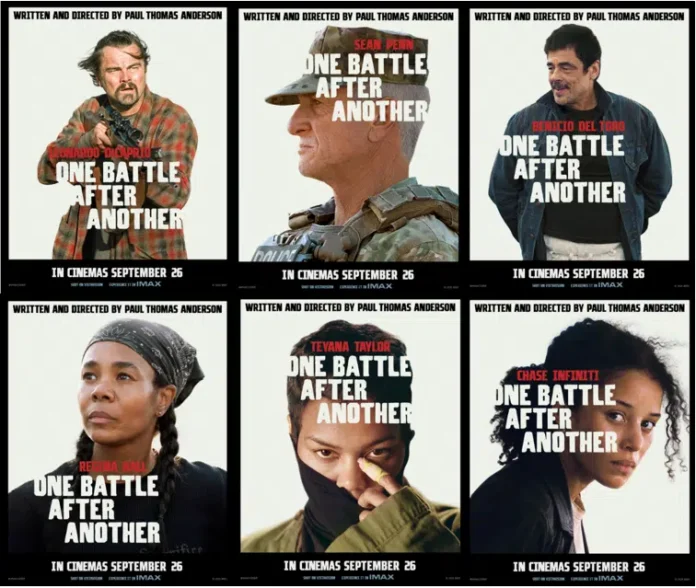
Leonardo DiCaprio plays a gonzo rebel named Bob Ferguson who changes his name and identity and goes underground after he becomes a wanted man. His group, the French 75, are like an even less organized Weather Underground who live by the lyrics to Gil Scott-Heron’s 1974 anthem, “The Revolution Will Not Be Televised.” Bob has a lover and partner in crime, named Perfidia (a stunning Teyana Taylor) who’s a lot tougher than him (not hard since he mostly smokes dope and follows orders) and takes more risks. At one point Perfidia acts her name and secretly succumbs to the rough advances of a screwy military man named Colonel Steven Lockjaw (Sean Penn, aiming for a third Oscar). She eventually disappears completely underground, leaving Bob with a baby girl that may or may not be his.
We jump forward 16 years until the girl, Willa, played with aplomb by newish Chase Infiniti, having been raised by Bob, becomes a pawn in Lockjaw’s game to bring Bob to justice. Unfortunately, Lockjaw is missing several bulbs in his chandelier. He’s a terrifying company man who now harbors this possible secret of fathering a black child while, as a solid racist, he’s trying to gain membership in a white supremacist cabal of billionaires called the Christmas Adventurers Club. It’s unclear what he will do to Bob and Willia if he finds them even if she is his daughter.
There are plenty of tanatlizing subplots and impressive supporting characters. Chief among them are Benicio del Toro, who runs a martial arts club as a front for political activities, and Regina Hall as an Earth mother in the organization. They’re collaborators who live in public as part of a vast network of revolutionary sympathizers. Alana Haim, in a smaller role, is one of the network.
There are also a lot of minor characters written so sharply that as they pass through the film, you happily accept them. Anderson’s script could have been another free-for-all like “Inherent Vice.” But it’s so well delineated that you don’t get bogged down or confused ever. The movie has one guiding point: to reunite Bob and Willa after they’ve been separated, and to keep them free of the law.
All the while, Jonny Greenwood’s tension filled score pulsates under the high emotions, Michael Bauman’s cinematography, and Colleen Atwood’s costumes fit seamlessly into Anderson’s vision. As the director builds to a desert highway chase sequence in the last third all of these elements combine for a path to a thrilling ending.
“One Battle After Another” is fiction, of course. But Pynchon and Anderson drew their revolutionaries — and their shady government and corporate enemies — on ideas that have existed since the 60s: Are the French 75 crazy or do they know something we refuse to acknowledge? Are they waging a war in an alternative universe?
Di Caprio is an elusive fellow in real life, but as with most of his movies, he’s a consummate actor. No one plays goofy better, whether he’s slinking out of the country club in “Wolf of Wall Street” or getting drunk on his pool float in “Once Upon a Time in Hollywood.” Bob Ferguson is simultaneously the dramatic heart of “Battle” and the comic relief. When Anderson uses “Green Acres” lyrics from the Gil Scott Heron song as code among the French 75, Di Caprio pulls of the ridiculousness without losing a beat.
Of course, that’s the thrust of the film. Bob Ferguson has spent 16 years getting high since almost getting arrested during his halcyon days. He can’t remember the pass phrase or code when he calls in to rebel headquarters. He’s constantly asked “What time is it?” by someone at the other end of the phone. He can’t remember if he ever knew at all. It’s hilarious and profound.
Lockjaw is Penn’s best character in years. In years. A very public liberal, Penn plays the rigidly conservative and dangerous rogue colonel for all he’s worth. But it’s not parody. It’s a shocking portrayal of a sad man in decline. By the end of the movie you can only feel sorry for Lockjaw. Both DiCaprio and Penn are at the top of their games.
“One Battle After Another” is a big deal, a roiling satire that connects the dots to today from 50 years ago. After brilliant films like “Magnolia,” “Boogie Nights,” “The Master,” “There will Be Blood” even “Licorice Pizza,” Anderson has found his moment. A big fan of Robert Altman, you can see the influence throughout “One Battle,” but it’s still PTA’s movie through and through. What a pleasure.
“One Battle After Another” opens next Thursday night, September 25th. I’m seeing it again in a few days and will have more to say, no doubt.

