
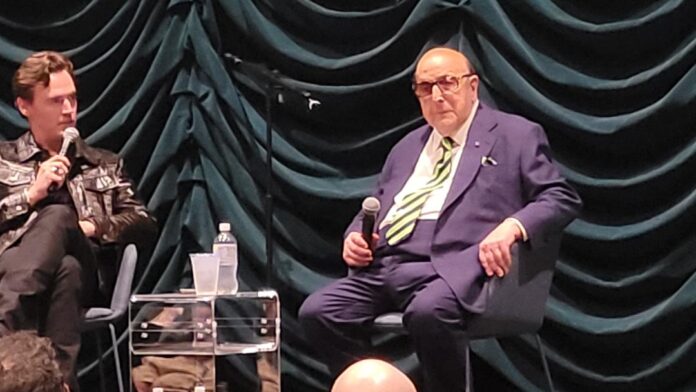
On Friday night I found myself in the charming, horsy village of Bedford, New York for a very special screening.
Tentatively titled, “Do You Remember?,” this 90 minute film probably will never be released for public consumption. Clearing the music rights would be unimaginably difficult– and expensive.
A little over three years ago, a version of the film was shown at music mogul Clive Davis’s 90th birthday party at Casa Cipriani in New York. Now a tighter version, with quite an emotional wallop, made it to the screen at the Bedford Playhouse, which not uncoincidentally is named for Davis, who lives nearby.
The film is the work of superstar music producer Mark Ronson, along with actor/producer Erich Bergen. It show cases Davis’s remarkable career in pop music by offering an aural and video jukebox of hits he made or was associated with over more than 50 years. (Ronson’s mixes, and segues, are really spectacular.)
One after another, starting with Columbia Records acts like Blood, Sweat Tears, Sly & the Family Stone, and Janis Joplin, Ronson ticks off hundreds of pop hits, wending the way through Davis’s creation of Arista Records in 1974 with Barry Manilow and Melissa Manchester, his resurrection of Aretha Franklin and Dionne Warwick, to the discovery of Whitney Houston, Santana’s Grammy winning revival, and the launch of Alicia Keys, among others.
Intermittently, we see Davis briefly at different times in the chronology — including a famous clip of him circa 1973 when he was so moved by the lyrics to Bruce Springsteen’s new song, “Blinded by the Light,” that he sent out a clip to the Columbia Records salesforce of himself reading them aloud.
The film is an astonishing walk down memory lane as the music speaks for itself. Some songs and performances are in whole, some are just nanoseconds. But did we forget that Davis also resurrected rock bands at Arista, including The Kinks and The Grateful Dead? That he was the guy who signed the original “American Idol” winners — like Carrie Underwood and Kelly Clarkson — to contracts? It’s a little mindblowing when you see him, in a white tennis sweater, sitting in a field of hippies at the Monterey Pop Festival, jiving out to Janis Joplin. He signed her to Columbia right after that. And let’s not forget Patti Smith, who was as cutting edge as could be in 1974, and Davis cross pollinating her with Springsteen in 1978 for “Because the Night.”
There were a couple of Davis’s friends in the audience at the Playhouse including “Titanic” actor Billy Zane. But 95% of the people were local music fans who were disarmed by the film’s magnitude. I know I was. A Q&A followed with Bergen (whom you know from the “Jersey Boys” movie and “Madame Secretary” on TV) and Davis on stage. I think it was taped. The interview should be in the Rock and Roll Hall of Fame.
Maybe the whole film will be there one day on display. Davis — who is known among his fans for occasionally telling a long story — concisely explained the history of pop music during its heyday. But what does explain Davis’s run in the music industry? Maybe only Berry Gordy at Motown and Ahmet Ertegun at Atlantic came even close.
There is no other record company president whose career has had such breath and depth. The stars all loved him and even when they disagreed with him — and came around later to thank him. That’s saying a lot. Stars who didn’t want to record songs that later became hits, who took advice they might not have embraced, are all here, documented, happily, in their appreciation.
One story David didn’t get to tell. It came up during the pandemic when he interviewed Springsteen for the charity fundraising Quarantunes Zoom calls. (I hope those interviews see the light of day soon.) Bruce actually brought it up — that Davis, visiting him at an early rehearsal, suggested Springsteen “not just stand here” on stage during his songs but “move around” a bit. Bruce, who’d already taken Davis’s advice to go home and write two hits for his debut album — they became “Blinded” and “Spirit in the Night” — took that advice, and is still running around arena and stadium stages to the awe of massive crowds.
PS Best line of the night. Bergen asked Davis if he always knew this is how it would all work out, if he always knew how to embrace his history as something momentous. Davis, unflinching, responded, “No. I’m Jewish! I fear the future.” Wow. But he barreled ahead, a lesson to us all.
This isn’t in the film, but just FYI:

