
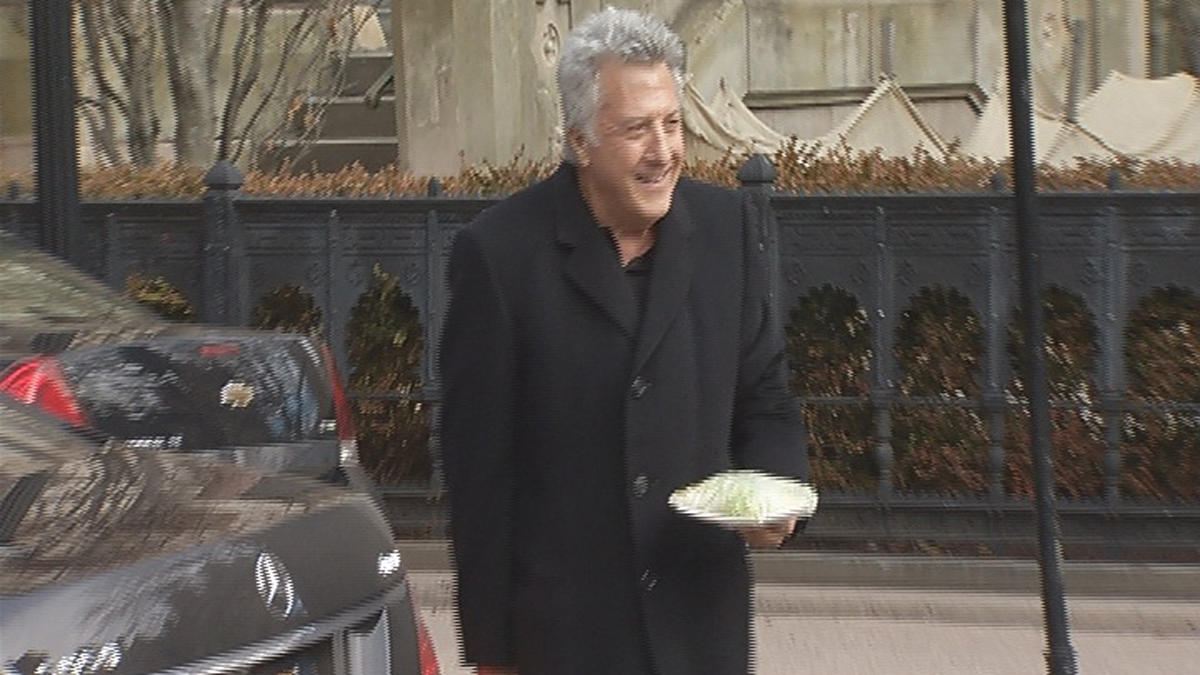
Mike Nichols’ “The Graduate” made Dustin Hoffman — who went on to win two Oscars — a superstar when it was released in 1967. Before he was even divorced, women were chasing him and vice versa. (If there had been social media, he’d have been finished.)
In his book called “Look at Me,” released today, he remembers just looking at a girl on the street, and that was it. What a time to be alive, long before AIDS and just as the sexual revolution was taking off. (“Look at Me” is quite the companion piece to Michael Douglas’s new memoir — to be a young Jewish movie star!)
Hoffman recalls observing this while smoking a joint with Paul Simon:
“Women were often literally waiting for me on my doorstep. I remember Warren Beatty telling me once that when he was living in the penthouse of the Beverly Wilshire, he would go downstairs to the bar or the pool, meet someone, and go right back up with her. “You never had to leave the building,” he said. That’s what it was like.
…I understood that fucking a famous person is like getting an autograph: it’s the famous that matters… the person is interchangeable. It may have troubled me that these women were only attracted to my celebrity. But I managed to persevere. I was quite immoderate. It was a strange and novel thing to imagine that now “I slept with Dustin Hoffman” was something a woman might say as a boast rather than an admission.”
Hoffman is incredibly candid about most everything, including how he met his second wife, Lisa (now celebrating their 46th anniversary). She’d had a crush on him as a child. Their families were friends. Hoffman was 39 and still married. (His first wife, Anne Byrne, is an actress who appeared in Woody Allen’s movie, “Manhattan.”) Lisa was 22. But it seems to have worked. They have four adult children and are closer than ever.
“Look at Me” is filled with stories about all his movies, co-stars, and friends. Everything we’ve read and heard about Hollywood in the 70s and 80 is true including hanging with Warren, Jack, and Bob (Evans), and their loyalty to each other. Hoffman notes that when Evans lost his house, Nicholson bought it back for him. “You don’t hear stories of loyalty like that in Hollywood every day,” Hoffman notes.
There are so many bon mots, I’ll bet Hoffman could publish a second volume without any trouble. During one memory of shooting Barry Levinson’s “Wag the Dog” with Al Pacino and Robert De Niro, he recalls how often all three of them are confused for one another. He says someone on a plane asked if The Godfather was one of the favorite movies he made!
What movie roles did he turn down? Apparently, the main character in Woody Allen’s “Broadway Danny Rose.” Why? He was “too snobbish,” he says. Also, the role in “Schindler’s List” that made Ben Kingsley a star, and Kingsley’s Oscar winning role in “Gandhi.” (“I remember saying to the director, Richard Attenborough, “So all the other actors will be Indians and I’ll be painted brown? That doesn’t sound like such a great idea.”)
Also, Hoffman says in a footnote, the original idea for “Rain Man” was for him to play Charlie, and Bill Murray play Ray.
Much, much more — a treasure trove of Hollywood history! (If only the publisher had sent the book in time to really swim around in it. But my $16.99 paid to Kindle was well worth it!)
PS The New York Times review of this book is a little cuckoo. Just ignore it.

